Bayesian imputation
Demographic imputation across 120M U.S. households
120M households · 10M points · ~1M params
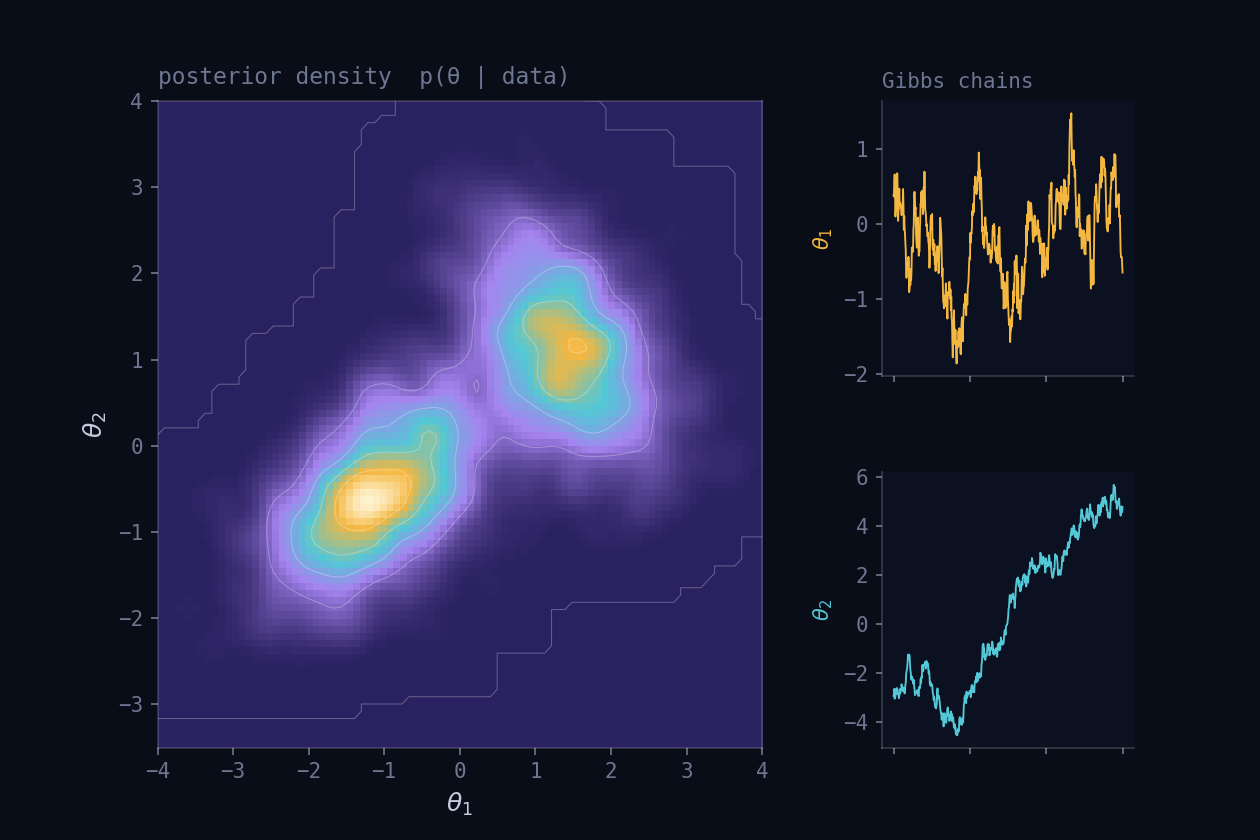
Designed and implemented a Gibbs sampler for Bayesian non-parametric density estimation (Hierarchical Dirichlet Process Mixture Model) to fill missing demographics in a deeply nested household structure — tuned to run over 10 million data points and roughly a million parameters.
Graph modeling
Identity graph construction
100M nodes · 1B edges
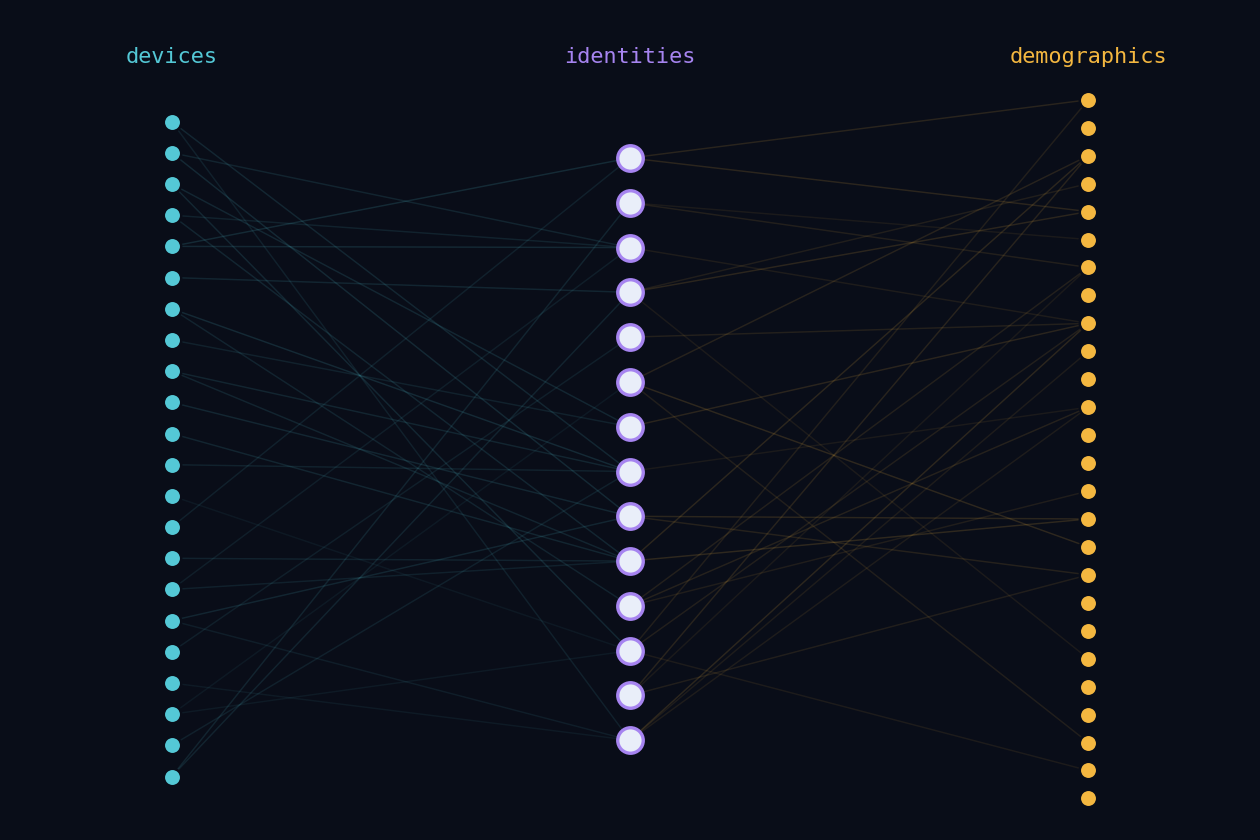
Built a probabilistic framework for the evolution of interconnected bipartite graphs, linking devices, identities and demographics from multiple sources over time, with an emphasis on geographical consistency.
Point processes
Behavioral modeling
100K+ time series · zero-inflated · autoregressive
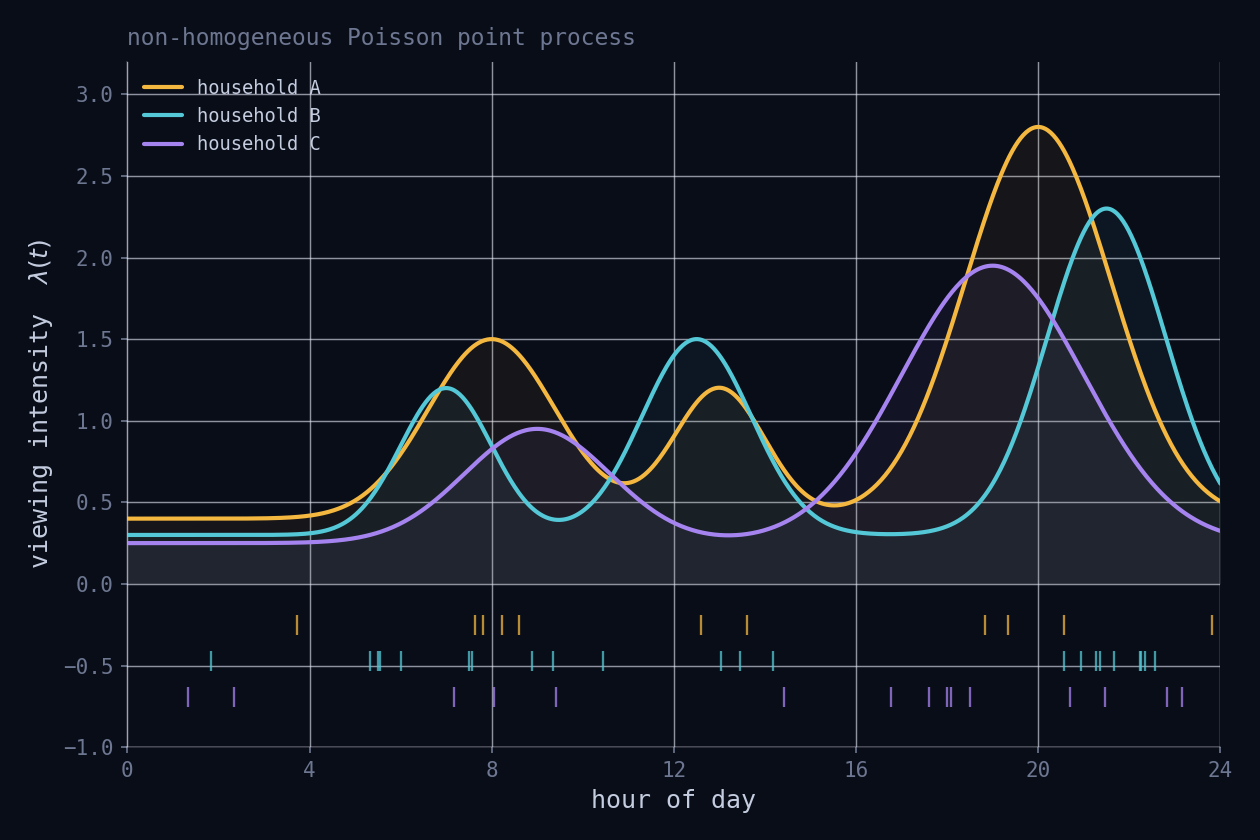
Modeled purchase, digital activity, and TV-viewership as household-level doubly stochastic Poisson point processes (or 'Cox processes'), separating the true event-generating rate from selection and masking effects with a zero-inflated, hierarchical model that shares information across households. Covariate link functions and autoregression let each household's intensity depend on its attributes, on time, and on its own recent history — across 100,000+ time series.
Measurement
Survey-based lift methodology
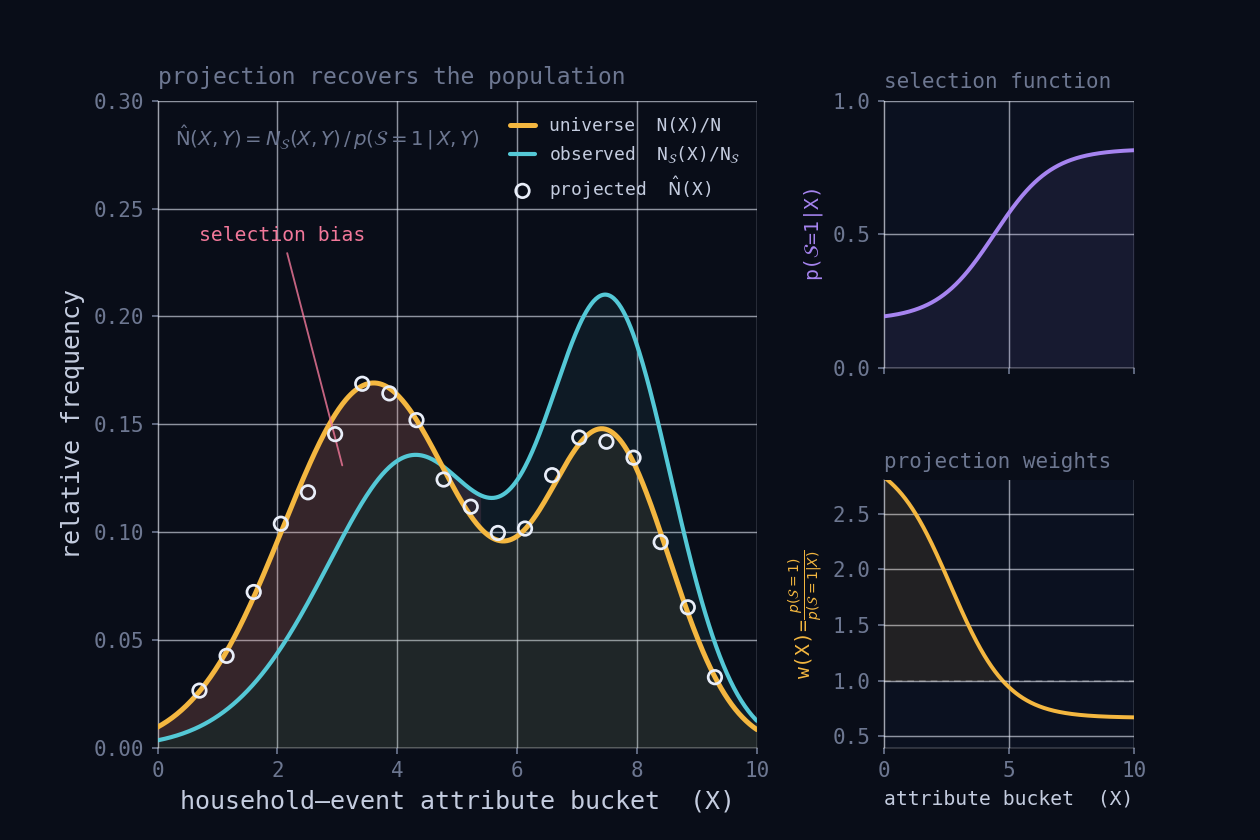
N(X,Y) = Nₛ(X,Y) / p(S=1 | X,Y)
Built a projection framework for unbiased measurement of household–event pairs under incomplete observation. From an exchangeability argument it recovers any population quantity by dividing the observed count by its probability of being observed — inverse-probability weights set by identity-graph matchability and observability — while estimating the total universe intensity jointly. It turns a biased, partially observed panel into calibrated, unbiased ad-effectiveness estimates.